
Your prospects are not scanning ten blue links anymore. They ask ChatGPT, Gemini, or Claude a question in plain English. Who does short-run packaging near Philadelphia. Who runs variable data direct mail.
The answer names a few companies. If you are not one of them, you were never in the running. You did not lose the job. Nobody looked at you.
Getting named in those answers is what Answer Engine Optimization, or AEO, means. Four things worth knowing:
1. AI Search Is Taking a Bigger Bite Every Month
Graphite’s March 2026 research found that AI assistants now generate sessions equal to 56 percent of global search engine volume.
Searching itself did not shrink. People are asking more questions than ever. They are just asking a growing share of them in AI, and that share climbs every quarter.
Forrester surveyed 18,000 business buyers in January 2026. Ninety-four percent used AI during their most recent purchase, and they ranked it a more meaningful source of information than talking to a salesperson.
Buyers of print are building their shortlist before they visit anybody’s website and before they take anybody’s call. Most of commercial print is not working that front yet. That is the opening.
2. Use AI to Personalize Content, Not to Write It
It is not that AI content is bad. It is that bad AI content is bad.
Generic content does not get quoted because it is generic. These engines hunt for the most specific, most credible source on a subject. If your page says the same thing in the same order as four hundred other printer websites, there is no reason to pick yours.
I recently ran a printer’s web copy through an AI detection tool. It came back 92 percent likely AI-generated.
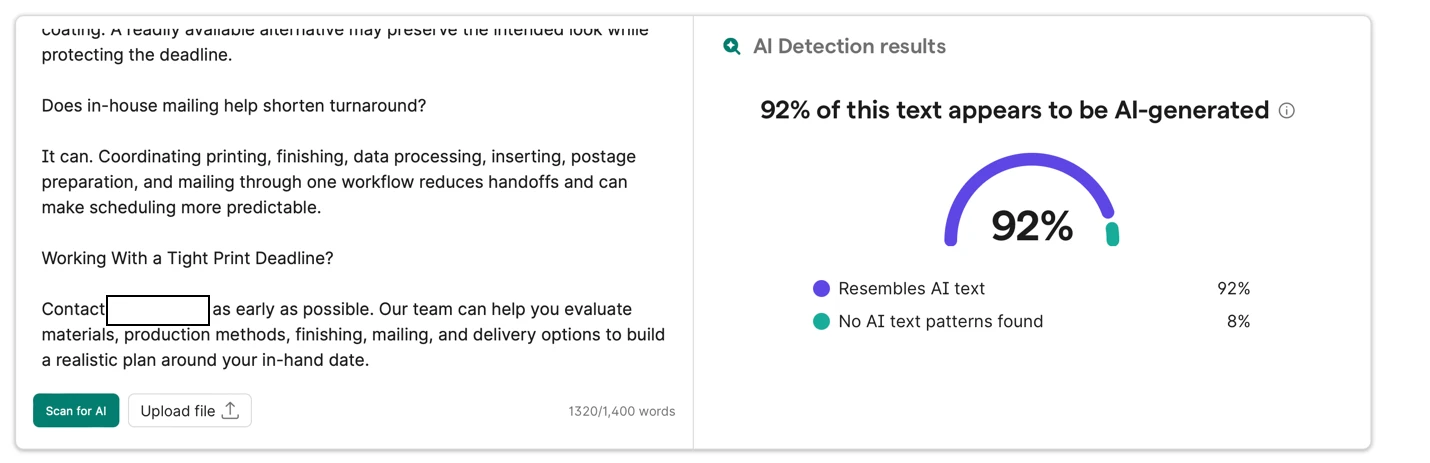
That is what I mean by an AI penalty. The engine sees no value in content like that, and worse, it casts a fog over the rest of the site, making it harder for AI to analyze the domain and rank the company at all.
Start with original content. A real opinion, a real number, a real job. Then use AI to adapt it. Localize it, adjust the tone, tighten it, cut it down for a newsletter. I call that original content because it is original to you. Use AI to organize and structure it, not to produce it.
3. LinkedIn Handed Everyone a Button That Costs You Reach
On July 30, 2026, LinkedIn added a “Seems like AI slop” option to the three-dot menu on every post and comment. Anyone can flag your post. Flagged posts get less reach, and you find out privately in your analytics.
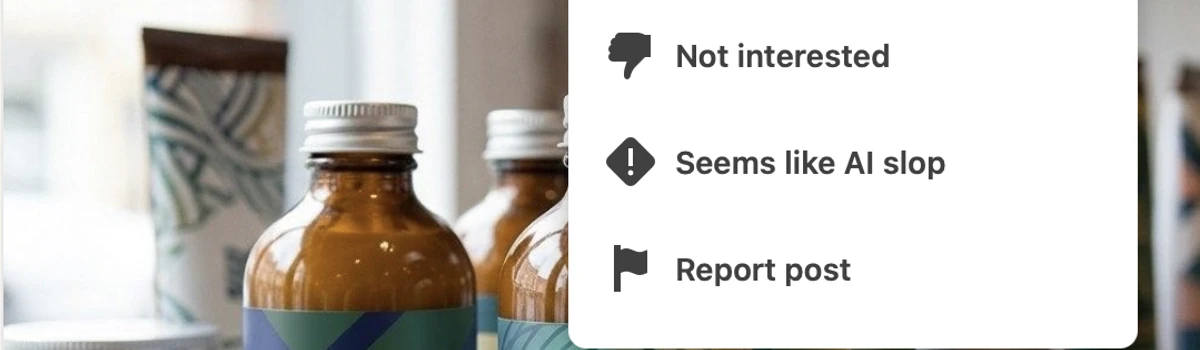
LinkedIn’s chief product officer says the button has been used more than a million times, and views on content the platform classifies as slop dropped about 40 percent within weeks.
LinkedIn is one of the top four places AI engines look when they size up a company. A throttled post does not just underperform in the feed. It stops working for you everywhere else. Use AI to proofread, never to draft.
4. Content Is a Program, Not a Project
AI engines do not handle one question at a time. They break a prospect’s question into a dozen related ones and look for a source for each. You need specific coverage across a whole subject, so that however the question gets sliced, you are in there.
A printer who publishes twelve solid, original, locally specific articles a year will beat the one who published forty in a weekend and then stopped. Pick a cadence and hold it. Blog on schedule. Send the newsletter. Update the numbers and the equipment on your service pages.
Where This Leaves You
Search did not go away. It moved. The printers who get named in AI answers over the next two years will be the ones publishing original, specific, regularly updated content, starting now.
Original content is the foundation of AEO. That is what we build for you.
Questions about getting your printing company named in AI search results? Learn more about our AI Search Optimization program, or contact us for a free marketing & AI review.